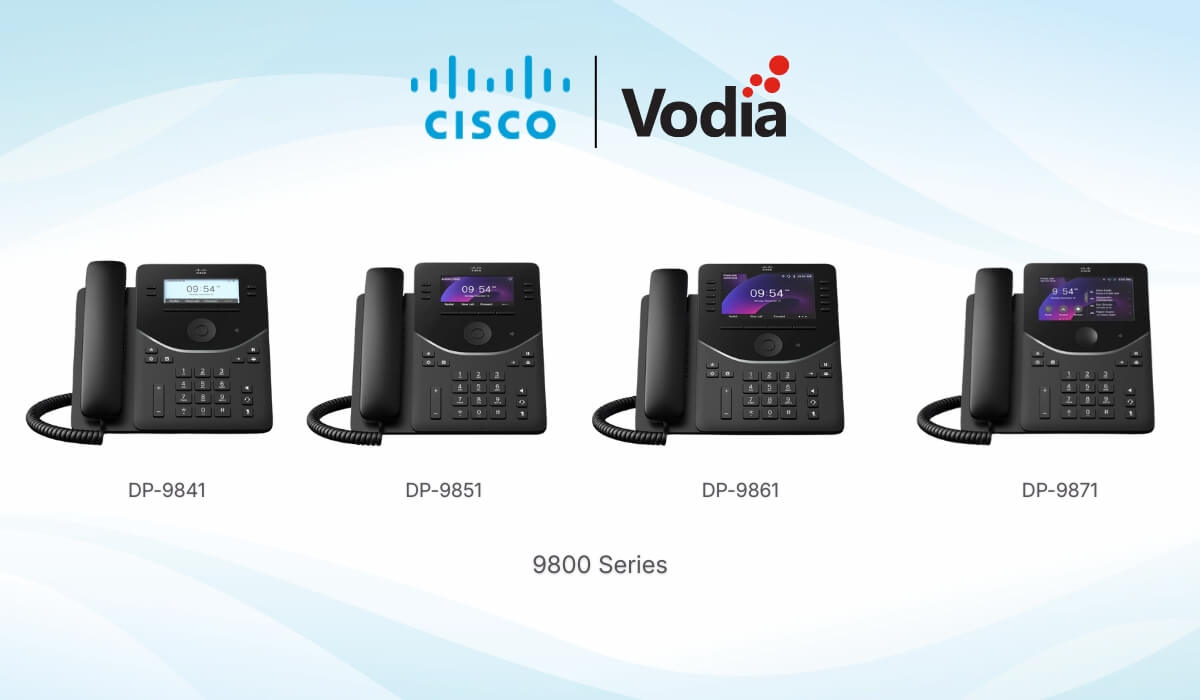
Vodia recently announced our PBX supports Cisco IP Phone Series 6800, 7800, and 8800 devices running Multiplatform (MPP / 3PCC) firmware, and we are pleased to announce we also support the Cisco IP Phone Series 9800, Cisco’s newest flagship IP phone series.
With Vodia, Cisco MPP phones can be onboarded and managed within the PBX, including configuration and firmware version control using Cisco-provided Multiplatform firmware. This permits organizations to continue using existing Cisco hardware in on-premises or cloud PBX deployments.
Overview of the Cisco IP Phone Series 9800
The Cisco 9800 IP Phone Series has been designed to transform workplaces by narrowing the gaps between calling, hybrid work, and meetings - it’s a cost-effective solution for workstations at scale. Each phone includes Cisco’s new PhoneOS software, which simplifies the user experience and complements Cisco’s video portfolios of RoomOS devices, for seamless collaboration and communication between workstations and conference rooms. With a suite of features built into the 9800 series, these state-of-the-art IP phones combine desk reservations, emergency notifications, meetings, and secure enterprise calling in a single phone.
9800 Features and Benefits
- Action button: Instantly access essential scenarios, including emergency alerts, security, and broadcast/paging.
- AI Background Noise Removal: Ensures clear communication for recipients of outgoing calls.
- Desk reservation and hot desking: Staff sharing workspaces can reserve, book, and register a desk via their phones.
- One Button to Push (OBTP): Meetings can be accessed almost instantly from the 9800 screen.
- One platform with PhoneOS: A single device and software configured for all platforms, including Cisco Unified Communications Manager (CUCM), Webex Calling, and Broadworks.
- Security: Application, hardware-enabled, runtime protection.
Supported Cisco 9800 Devices (MPP Models)
- DP-9841-3PCC
- DP-9851-3PCC
- DP-9861-3PCC
- DP-9871-3PCC
Models ending in “-K9” are Cisco Enterprise (CUCM) phones and are not supported for direct use with Vodia.
Firmware Types
- Multiplatform (MPP / 3PCC) Firmware: SIP-based firmware used for third-party phone systems, such as Vodia, is distributed as ZIP archives containing a .loads firmware file. Please note: Cisco Enterprise (CUCM) firmware is not used in Vodia environments.
- Recommended Method (Upgrade Rule): Vodia recommends upgrading Cisco MPP phones using the Upgrade Rule. This method is persistent, provisioning-friendly, and suitable for production deployments.
- Cisco Browser-Based Upgrade: Cisco also documents a browser-based upgrade method that triggers a one-time firmware update. This method is useful for manual upgrades or recovery scenarios, but we do not recommend it for large deployments.
Documentation
Our documentation includes a demonstration video and supporting technical material for Cisco MPP (3PCC) provisioning. Please visit the Vodia Cisco 3PCC provisioning guide.
Vodia has been a VoIP pioneer for well over a decade, and our commitment to innovation includes ensuring our users have access to modern devices and third-party business communication software available (and we’ve been Microsoft Teams Direct Routing certified for our Session Border Controller). We offer the richest feature suite of any PBX in the industry, and we continue to add AI functionality to our platform. This includes the newest version of our PBX, Version 70, which is available as a preview build.
If you’re looking for a cloud phone system, contact us at sales@vodia.com or +1 (617) 861-3490.
About Vodia
Vodia Networks, Inc. provides B2B cloud communications solutions for enterprises, contact centers, and service providers. Its PBX software offers a broad range of business telephony features for on-premise and cloud deployments on Windows, Linux, and Mac. Fully SIP-compliant, Vodia integrates with numerous SIP devices and trunking providers for flexible telephony. Its multi-tenant platforms support desk phones, softphones, APIs, and third-party CRM integrations. Vodia empowers partners and users with world-class cloud PBX and personalized support to ensure success. The company operates globally, with offices in Boston, USA, and Berlin, Germany. Visit Vodia on LinkedIn, X, and YouTube.
.svg)