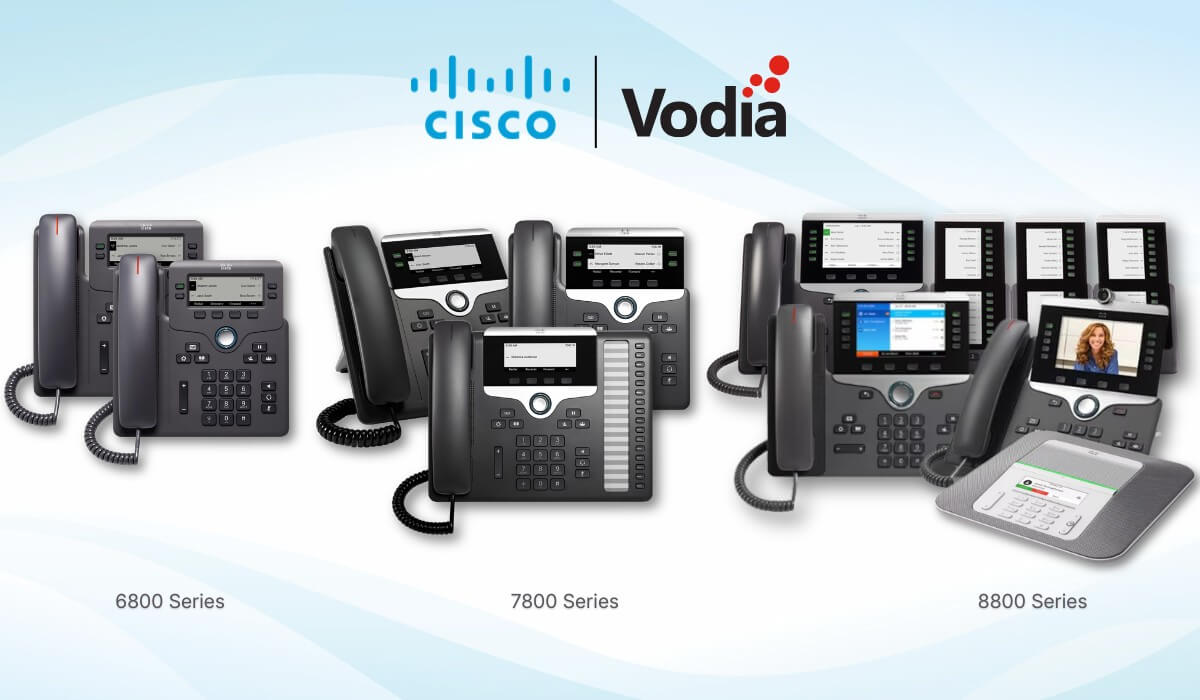
The Vodia PBX supports Cisco IP Phone Series 6800, 7800, and 8800 devices running Multiplatform (MPP / 3PCC) firmware. These models are widely used in enterprise and service provider environments and are commonly deployed with SIP-based third-party phone systems.
With Vodia, Cisco MPP phones can be onboarded and managed within the PBX, including configuration and firmware version control using Cisco-provided Multiplatform firmware. This allows organizations to continue using existing Cisco hardware in on-premises or cloud PBX deployments.
Overview of the Cisco IP Phone Series
6800
The Cisco IP Phone 6800 Series comprises multiplatform phones designed to be affordable, easy-to-use, and reliable for organizations with moderate-to-active VoIP usage. This series provides secure audio with industry-standard microphones and speakers.
- crystal clear wideband audio performance
- Gigabit Ethernet integration
- low power usage
- optional enhanced wideband audio handset for increased dynamic voice range response
7800
The affordable Cisco IP Phone 7800 series gives organizations of any size full-featured, robust, secure VoIP. 7800 phones can be deployed on-premises or via Cisco Webex Calling.
- backlit, pixel-based displays
- crystal-clear voice
- endpoint for small conference rooms
- fixed keys and two-way navigation for ease of use
- increased business call efficiency and productivity
- multiline models for desktops
- reduced IT operating costs
8800
The Cisco IP Phone 8800 Series with Multiplatform Phone Firmware was developed to enhance one-to-one communication within an organization while reducing Cisco Broadworks, Cisco Webex Calling, and Webex Calling Carrier operating costs.
- Cisco EnergyWise reduces energy costs after Close of Business (COB)
- excellent solution for mobile workers within a campus
- ideal for knowledge workers, administrative, and executive staff
- perfect for open workspaces, conference rooms, and executive offices
- select models support 720p HD desktop video collaboration
- telephony feature integration with personal mobile devices
- text-to-speech features
Supported Cisco Devices
- 6800 Series: CP-6841, CP-6851
- 7800 Series: CP-7821, CP-7841, CP-7861
- 8800 Series: CP-8832, CP-8841, CP-8845, CP-8851, CP-8861, CP-8865
Firmware Types
- Multiplatform (MPP / 3PCC) Firmware: SIP-based firmware used for third-party phone systems, such as Vodia, is distributed as ZIP archives containing a .loads firmware file. Please note: Cisco Enterprise (CUCM) firmware is not used in Vodia environments.
- Recommended Method (Upgrade Rule): Vodia recommends upgrading Cisco MPP phones using the Upgrade Rule. This method is persistent, provisioning-friendly, and suitable for production deployments.
- Cisco Browser-Based Upgrade: Cisco also documents a browser-based upgrade method that triggers a one-time firmware update. This method is useful for manual upgrades or recovery scenarios, but we do not recommend it for large deployments.
Documentation
A demonstration video and supporting technical material for Cisco MPP (3PCC) provisioning with the Vodia PBX are available in the Cisco 3PCC provisioning guide.
At Vodia, we continue to make sure we keep abreast of every development in the telecommunications industry, and this includes new devices: if it’s state-of-the-art, we want to make sure it integrates with our phone system, so our customers have everything they need to build the finest, most future-proof business communication ecosystem. If you’ve got a device or third-party business software platform you want to deploy with our PBX, get in touch with us at, sales@vodia.com or call +1 (617) 861-3490.
About Vodia
Vodia Networks, Inc. provides B2B cloud communications solutions for enterprises, contact centers, and service providers. Its PBX software offers a broad range of business telephony features for on-premise and cloud deployments on Windows, Linux, and Mac. Fully SIP-compliant, Vodia integrates with numerous SIP devices and trunking providers for flexible telephony. Its multi-tenant platforms support desk phones, softphones, APIs, and third-party CRM integrations. Vodia empowers partners and users with world-class cloud PBX and personalized support to ensure success. The company operates globally, with offices in Boston, USA, and Berlin, Germany. Visit Vodia on LinkedIn, X, and YouTube.
.svg)