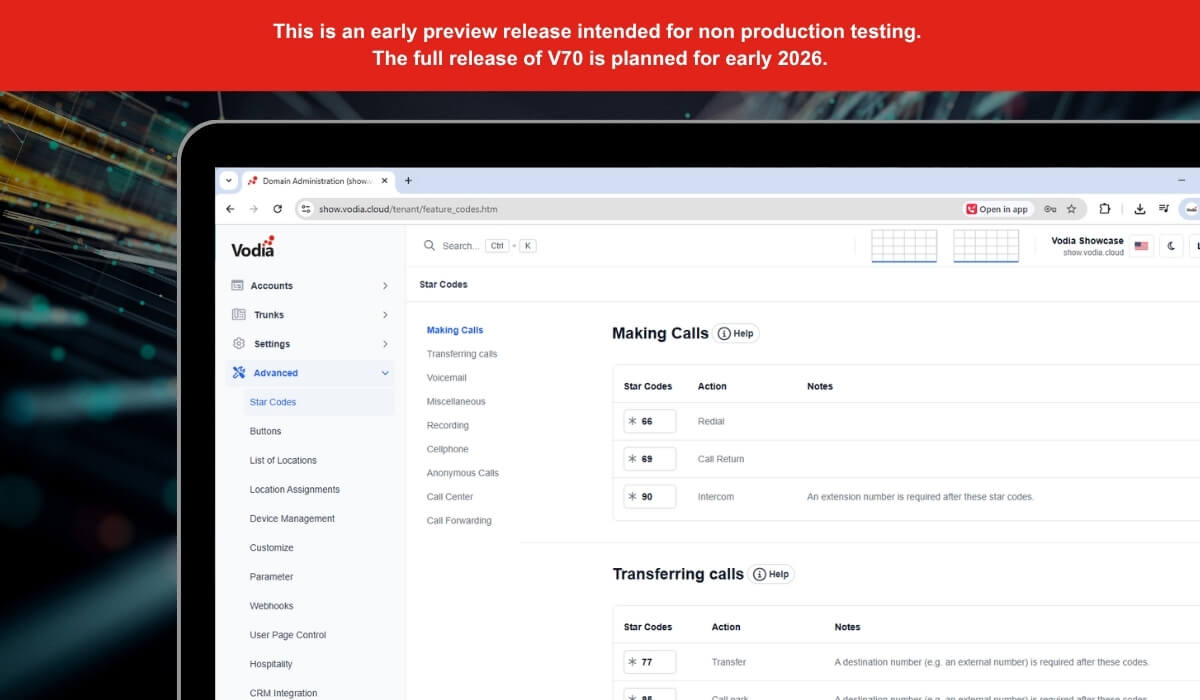
We’re excited to share the V70 preview build is now available: This is an early, pre-release version intended strictly for testing, evaluation, and feedback. Before we finalize the full production release next year, we want partners and administrators to explore the new interface, try the updated architecture, and help us validate the changes. The preview is available for CentOS64, Debian64, and Graviton; it offers an early look at some of the most significant improvements we’ve made to the Vodia PBX in years.
The first thing you’ll notice is the new administrator web interface. The V69 interface relied on an older framework, and while it served us well, it sometimes made the system feel dated next to platforms with more modern front ends, even when their backends were far less capable. V70 introduces a completely refreshed interface built on new technology. It feels cleaner, faster, and more consistent, while still keeping the functionality close to 1 to 1 with previous versions. If you know V69, you’ll feel right at home - just with a noticeably better experience.
There are also several long-awaited upgrades under the hood. The PBX can now use multiple CPU cores for media processing, which opens the door to handling more than a thousand calls on a single server. For partners with large multi tenant deployments, this is a meaningful boost in capacity and reliability.
We’ve also added the ability to share BLF status across tenants. This is incredibly useful in branch office scenarios, and it also creates a path for external applications to push presence information through the REST API. It’s a small change with a lot of practical impact.
Snapshot creation and restoration is now available as well. The first version uses a file system approach and gives you a straightforward way to roll back or recover a system. Our long term plan is to integrate this more deeply with hosting platforms, so snapshots can be handled at the virtualization layer.
Another improvement we’ve made, somewhat quietly, is centralized remote provisioning. While it isn’t exclusive to V70, we already back ported it to V69 - it reflects our ongoing goal to make new system and tenant installations as quick and seamless as possible while preserving the full feature set.
On the operating system side, we have updated our build environments. The Debian build is now compiled on Debian 12 and the CentOS build on CentOS 10. The Windows version is still in progress, but it will be ready by the time we ship the full release. Support for running V70 on the embedded Vodia IOP, based on Raspberry Pi, will also be in place for the final launch.
And what about V69? Version 69.5 remains a stable and dependable release, and we plan to keep supporting it. Many customers continue to run older versions, and we understand not every environment needs or wants to adopt new releases immediately. We are comfortable offering V69 for new installations, especially since it’s still easy to keep provisioned phones up to date.
We’ll be giving the V70 preview more visibility through the end of the year. The goal is to release the production ready version in early 2026. Since this is still a preview, some parts of the interface, form validation, and translations may be incomplete. If you see anything that looks off, please open a ticket or email v70feedback@vodia.com so we can review it. Your feedback at this stage genuinely helps us finalize the release.
To give you a closer look at what’s coming, we’ve added a few screenshots from the preview build below. These are not final, but they offer a clear glimpse into the updated interface and overall direction of V70.
.svg)