Communication Systems: Finally Catching Up to Modern Technology or Still Stuck in the Past?
Published on:
May 6, 2026
Business communication systems have evolved rapidly, but many organizations are still dealing with fragmented tools, limited visibility, and growing operational complexity. As more platforms and channels are added, clarity often decreases, making it harder to manage workflows, respond in real time, and maintain control. A modern approach requires consolidating systems, improving visibility, and reducing noise to create a more efficient and manageable communication environment.
With the ongoing rise of AI, business communication systems are in the midst of rapid evolution, driven in large part by innovators such as Anthropic, Google, and OpenAI. What was once consigned to science fiction has become part of daily operations, with chatbots, smartphones, and video conferencing now central to communication environments at both enterprises and SMBs. The amount of data, and the speed at which it travels, is staggering.
At the same time, we are seeing a constant stream of alerts, tools, and information flowing across systems. Tech stacks continue to expand, but in commercial environments, the objective isn’t more input - it’s clearer, quicker resolutions. While communication, both within an organization and CX, sits at the core of any operation, many systems add complexity that impedes operations.
Communication has become operational
Business communication has largely kept in step with new channels and platforms - it’s no longer just voice. Chat, SMS, social media, and video conferencing are now part of a broader communication layer that supports not only customer service but also internal daily operations and workflows, as a key component of collaboration and overall efficiency.
Every interaction triggers events across systems and teams. Communication is no longer a standalone function. It is part of how organizations operate.
Problems - and their consequences
Despite this evolution, many organizations are still working with fragmented systems. Inflexible routing, fixed logic, disconnected channels, and multiple interfaces create noise instead of clarity. As more tools are added, visibility does not improve. It becomes harder for organizations to identify what actually matters.
Users are often forced to search through unnecessary or irrelevant data, which blunts decision-making and reduces responsiveness.
The consequence is a complex system that’s difficult to navigate and even harder to manage in real time. As organizations scale, this complexity increases, resulting in reduced efficiency. More tools introduce more fragmentation, reducing control rather than improving it.
A few common outcomes:
Employees wait hours for support tickets
Error-prone offboarding exposes the organization to insider risk
Overspending on SaaS licenses
Revenue stalled by a failed SOC 2 audit (nobody tracks compliance in real time)
Unmanaged access and weak credentials
Slow, reactive fixes instead of proactive responses.
The true consequence, though, is not just inefficiency, but the time and money spent managing communication infrastructure instead of improving products, services, and customer experience.
Complexity impedes security
Bolting multiple platforms and third-party software will do nothing to bolster your overall security. It often does the opposite.
Fragmented systems increase the attack surface, create inconsistencies in configuration, and make access control harder to enforce. At the same time, when working with a multi-component system, the risk of missed alerts increases, as does the delay in responses to these alerts.
This is reactive security, rather than real control and fortification, and the blurred visibility makes it harder to manage and respond to risk.
Addressing this requires more than adding another layer of tools. It calls for a shift toward systems that reduce fragmentation, improve visibility, and enforce consistent control across the entire communication environment.
What a modern communication system should deliver
A modern communication system should reduce noise, increase clarity, and simplify how different components work together. The system should be simple for users, intuitive, and without unnecessary complexity.
This means moving away from static, rigid behavior toward real-time awareness and coordinated control. Instead of adding more layers, the system should consolidate them.
That includes capabilities built into the system, not added as separate tools:
Real-time dashboards that surface relevant information, not just more data
Administrative interfaces that reduce friction instead of adding complexity
Event-driven alerts that are clear, actionable, and prioritized
Built-in automation and AI that support decision-making, rather than complicate it
Centralized control that keeps configuration consistent across the system
A shift toward clarity and control
The Vodia cloud phone system has been built around this approach. Rather than adding another layer of tools, it focuses on reducing fragmentation and improving operational visibility.
Key capabilities include:
Custom dashboards providing real-time system visibility
The goal is not to add complexity, but to replace it with a system that is easier to manage, easier to scale, and easier to understand.
If your current communication environment is fragmented and difficult to control, it may be time to rethink how those systems are structured. The Vodia PBX gives you everything you need for an impeccable - and simple - communications ecosystem.
We can help you reduce complexity, increase efficiency, and create an environment for growth and profitability. Contact us at sales@vodia.com or +1 (617) 861-3490.
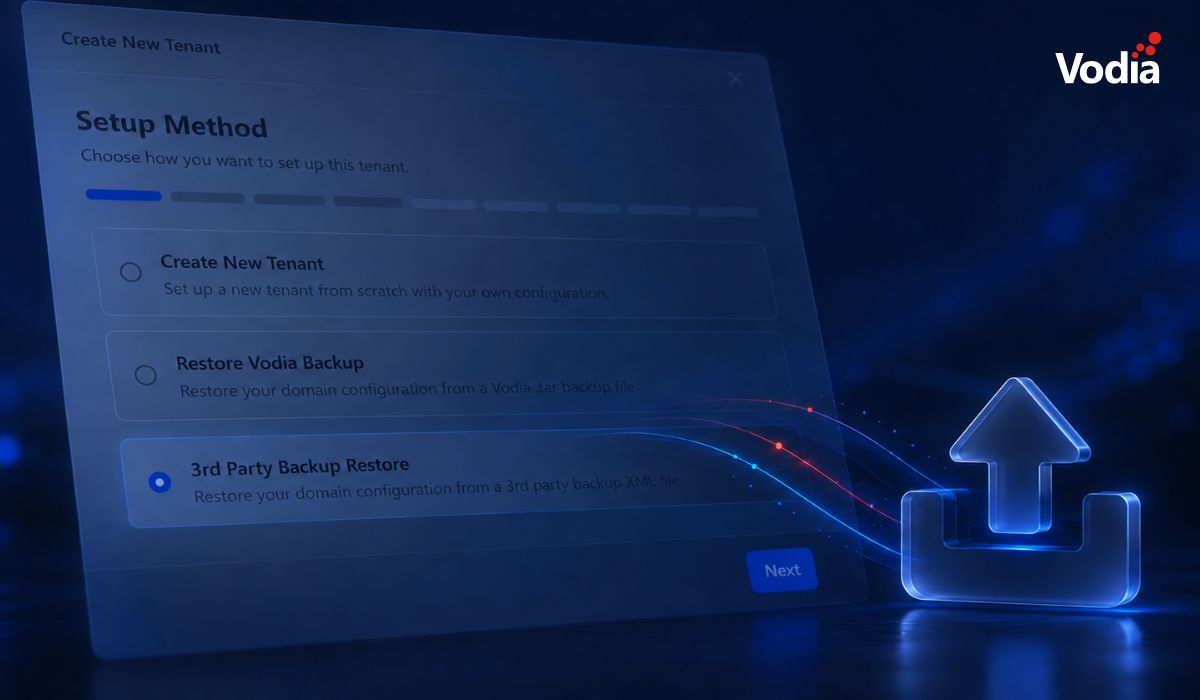
Switching phone systems doesn’t have to mean rebuilding everything from scratch. The Vodia PBX migration tool imports key configuration data from backups, including extensions, ring groups, queues, desk phones, and basic auto-attendant settings. Built into the Vodia Admin Portal, it guides administrators through the import process and reduces repetitive manual work, whether you’re moving 10 extensions or 1,000. Explore what transfers, what needs manual setup, and how the built-in tool reduces repetitive work when moving to Vodia.
Apps have changed how businesses communicate and work, but every digital experience still depends on physical hardware. From smartphones, desk phones, and headsets to networking equipment and cloud servers, reliable infrastructure supports productivity, security, and call quality. Here’s why hardware still matters in an app-first world and what businesses should consider when choosing dependable devices and secure connectivity for the office, hybrid teams, and remote work, while preparing for evolving technology.
Vodia Wallboards gives supervisors, contact centers, service providers, and operations teams a self-hosted, real-time view of Vodia call queue activity. Monitor waiting, ringing, and active calls; agent availability; service levels; abandoned calls; and queue trends across one or more Vodia PBX systems. Start with a ready-made layout or build a custom wallboard using queue filters, live widgets, AI summaries, and alerts. Display the information your teams need in a browser, on an operations dashboard, or on a dedicated TV screen.
.svg)