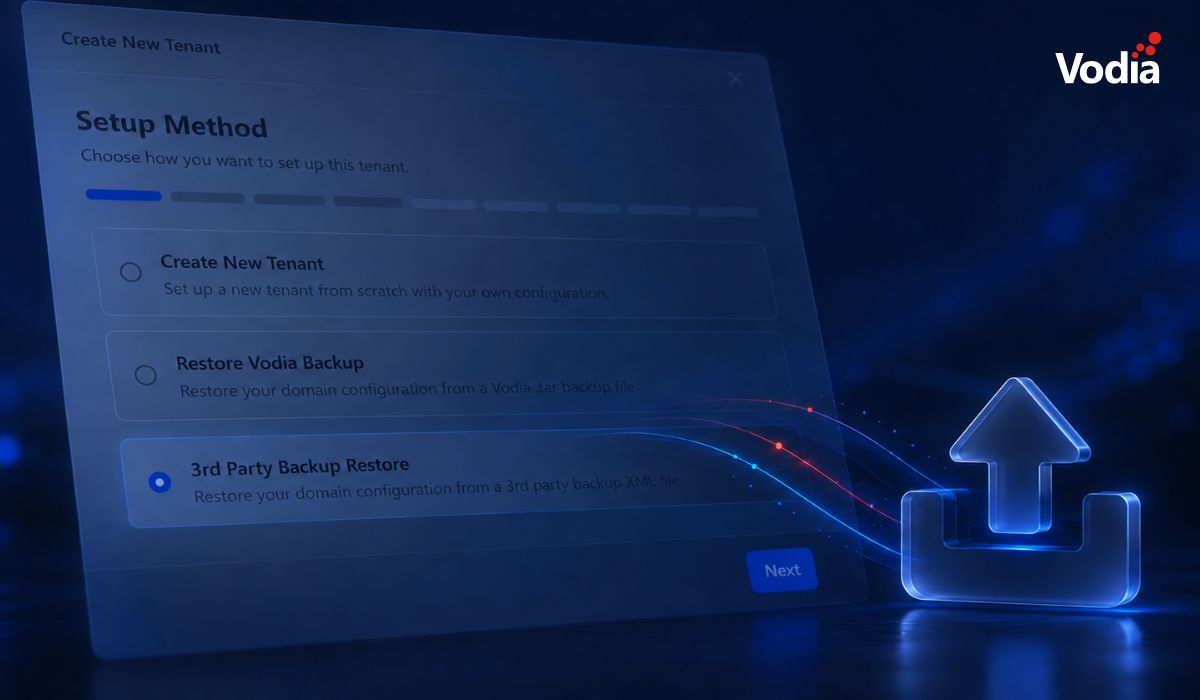
Version 70 of Vodia’s industry-standard cloud phone system, available for preview, is the next step in the evolution of our PBX. We’ve introduced a redesigned, built-from-the-ground-up Admin Portal with modern web technologies - this new, powerful portal is a clean, easy-to-use, responsive interface designed for speed and efficiency.
Whether you manage one tenant or hundreds in a multi-tenant setup, cloud or on-premises, Version 70 will deliver faster navigation, smarter workflows, and powerful new capabilities for PBX administration that’s more intuitive than ever.
The Vodia PBX has long been the perfect backbone for any business communications ecosystem, and Version 70 will be an even stronger iteration of this backbone. One of the features we’ve improved is our support for Music on Hold (MoH). With Version 70, we turned our attention to improving the sound of MoH: our goal was to give our users neutral, calming sound of the highest quality, and we achieved it.
Music on Hold and the Caller Experience
Vodia is a long-time partner of one of the leading MoH providers, Easy On Hold. In a recent blog post on the company’s website, “Why Caller Experience Will Matter More Than Ever in 2026,” Easy On Hold has this to say about customer calls:
In 2026, more callers will reach out only after exhausting every self-service option available. That means when the phone rings, you’re no longer dealing with casual inquiries—you’re engaging with customers who want answers now and who expect to be understood immediately. Businesses that fail to examine what callers experience before they ever reach an agent risk losing those customers before the conversation even begins.
This insight applies directly to what happens while callers are placed on hold. While businesses can’t afford to miss calls, they also can’t afford to lose callers before an agent ever answers. Music on Hold plays a key role in keeping callers engaged and reassured during these moments.
Why Music on Hold?
MoH keeps callers connected while agents are on other calls and customers wait in call queues. When callers are placed on hold without audio (“dead air”), many will assume the call has dropped and will simply hang up, while callers who remain on the line often perceive that wait times are longer than they actually are.
With MoH (and outgoing informational messages), callers are more likely to stay on the line, and they usually feel they’ve experienced shorter wait times than they actually have. Key benefits of MoH include:
- callers know the call is still live (line is open)
- increased call retention
- a more positive sonic “atmosphere” during wait times
- reduced dropped calls and churn
- improved message absorption when informational messages are played during hold
Music on Hold and the Vodia PBX
The Vodia PBX supports both WAV and MP3 music files, whether your company has deployed a cloud or on-premises system, regardless of how many tenants are using the platform. Benefits include:
- emergency messages with automatic stop dates that can be added almost instantly to selected queues
- high-quality live audio streaming
- scalable, multiple streams for individual caller profiles
- streaming audio content that can be shared across multiple groups or assigned to individual call groups (geographic regions, sales, support)
Documentation
For more information on configuration and streaming options, refer to the Music on Hold documentation.
At Vodia, we continue to build and refine a cloud phone system designed to support real-world business communication. If you’d like to learn how we can help you improve the caller experience with Music on Hold that’s truly music to your customers’ ears, get in touch with us at, sales@vodia.com or call +1 (617) 861-3490. We’re playing your song.
About Vodia
Vodia Networks, Inc. provides B2B cloud communications solutions for enterprises, contact centers, and service providers. Its PBX software offers a broad range of business telephony features for on-premise and cloud deployments on Windows, Linux, and Mac. Fully SIP-compliant, Vodia integrates with numerous SIP devices and trunking providers for flexible telephony. Its multi-tenant platforms support desk phones, softphones, APIs, and third-party CRM integrations. Vodia empowers partners and users with world-class cloud PBX and personalized support to ensure success. The company operates globally, with offices in Boston, USA, and Berlin, Germany. Visit Vodia on LinkedIn, X, and YouTube.
.svg)