Resilience in Communication: Why Vodia’s Distributed Approach Leads the Way
Published on:
February 5, 2025
Vodia Networks utilizes a distributed architecture for its communication platform, reducing the risks associated with centralized systems. Unlike single-server solutions that create a single point of failure, Vodia’s approach spreads the load across multiple servers, ensuring continuous operation even in the event of hardware or software issues. Each server operates independently with its own data, enabling quick failover and minimizing disruption. On-premise deployment options provide additional control over security and performance, while the decentralized structure enhances resilience against large-scale outages and cyber threats.
In today’s always-on world, businesses depend on seamless communication to stay connected with customers and staff. But what happens when the system on which your organization relies faces a sudden outage? Recent events in the industry demonstrate how centralized infrastructures can leave businesses vulnerable to widespread and sometimes lengthy downtime.
Vodia Networks provides state-of-the-art cloud communication solutions tailored for enterprises, contact centers and MSPs. With Microsoft Teams certification and support for over 5,000 extensions per virtual machine, Vodia’s phone system stands out as the most feature-rich, scalable, and secure option on the market. Key for making this possible is its resilience at its core, ensuring our customers can communicate without interruption, even when faced with unexpected challenges and disruptions.
The Problem with Centralized Systems
Many communication platforms rely on centralized servers to manage operations. While this approach can simplify initial setup, it comes with a significant risk: a single point of failure. If the central server experiences an issue - hardware failure, software bugs, external attacks - the entire system can go offline, leaving your company scrambling to reestablish internal and external communications.
Centralized systems also face challenges when it comes to scalability. High traffic volumes or regional spikes in usage can strain resources, leading to degraded performance or outages. For businesses, these interruptions can mean lost productivity, missed opportunities and unhappy customers.
The Vodia Distributed Advantage
Unlike platforms that rely on a single central server, Vodia takes a distributed approach, giving users a distinct advantage. Our architecture leverages multiple servers to spread the load and minimize risk:
Distributed data: Every server contains the data that is needed for its operation. Access to that data does not depend on the network.
Easy failover: When hardware fails, the VM controller can be moved to another VM typically in less than a second, with calls staying up.
Limited damage: Even when a VM fails completely, the damage in a cluster is limited to that instance without impacting the operation of the other VM.
Simple backup: All data is contained in a single folder in the filesystem, making backups easy and compact.
On-Premise Options for Complete Control
For businesses seeking even greater control, Vodia offers on-premise deployment options. By hosting the Vodia PBX on your own hardware, you control the system’s performance, security and reliability. This is especially valuable for industries with strict compliance requirements or unique operational needs. Even when the servers are in the cloud, system administrators are in complete control of their PBX and are not depending on staff operating critical servers that can be easily overwhelmed when a central component fails.
Security and Peace of Mind
A distributed architecture doesn’t just improve uptime, it also enhances security. Decentralized systems are less vulnerable to large-scale attacks, as there’s no single target for bad actors to target and exploit. Vodia’s robust security features give you peace of mind in a turbulent digital landscape fraught with hacks, breaches and data leaks.
The Vodia PBX: The Smarter Way to Communicate
In an era where downtime isn’t an option, the best-in-class Vodia PBX is the industry leader and the best choice for organizations of all sizes, from enterprises to SMBs. By eliminating single points of failure, leveraging distributed infrastructure and offering on-premise options, we ensure your business stays connected, no matter what comes your way. Choose Vodia for a communication solution that’s as reliable as it is innovative. Contact us today to learn more about our innovative cloud communication solutions and to schedule a demo, sales@vodia.com, +1 (617) 861-3490.
About Vodia
Vodia Networks, Inc. is a pioneering provider of B2B Cloud Communications Solutions catering to enterprises, contact centers and service providers. Vodia's PBX software boasts an extensive suite of business telephony features for on-premise and cloud-based systems and operates seamlessly across Windows, Linux or Mac platforms. Fully compliant with SIP industry standards, the Vodia phone system integrates effortlessly with a wide range of SIP-based devices and trunking providers, granting ultimate freedom in telephony. Vodia’s multi-tenancy platforms are compatible with an unprecedented number of technologies, including desk phones, softphones and APIs, for myriad third-party software and CRM systems. Our mission is to empower our partners and end-users with the world's best cloud PBX and personalized support to ensure their success at every turn. Our US headquarters are in Boston and our European headquarters are in Berlin; we also maintain offices in Beijing, Hong Kong, Nicosia (Cyprus) and Sydney, Australia. Visit Vodia on LinkedIn, X and YouTube.
Following a critical PHP security advisory affecting installations worldwide, we temporarily restricted public access to some of our backend services while carrying out necessary upgrades. Access has now been restored, and the affected services are operating normally. The Vodia PBX itself does not use PHP and was not directly affected. We explain what happened, the changes to legacy licensing and TLS support, and why customers running older PBX versions should contact us for upgrade guidance.
Submitting a support ticket with the right information helps our team understand your issue and reduces follow-up questions. This step-by-step guide walks you through the Vodia Help Center, from describing the problem and attaching diagnostic files to setting the business impact and providing your PBX details. You’ll also learn which call details and timestamps to include, alongside practical tips to keep troubleshooting focused and help our support team investigate your issue more efficiently.
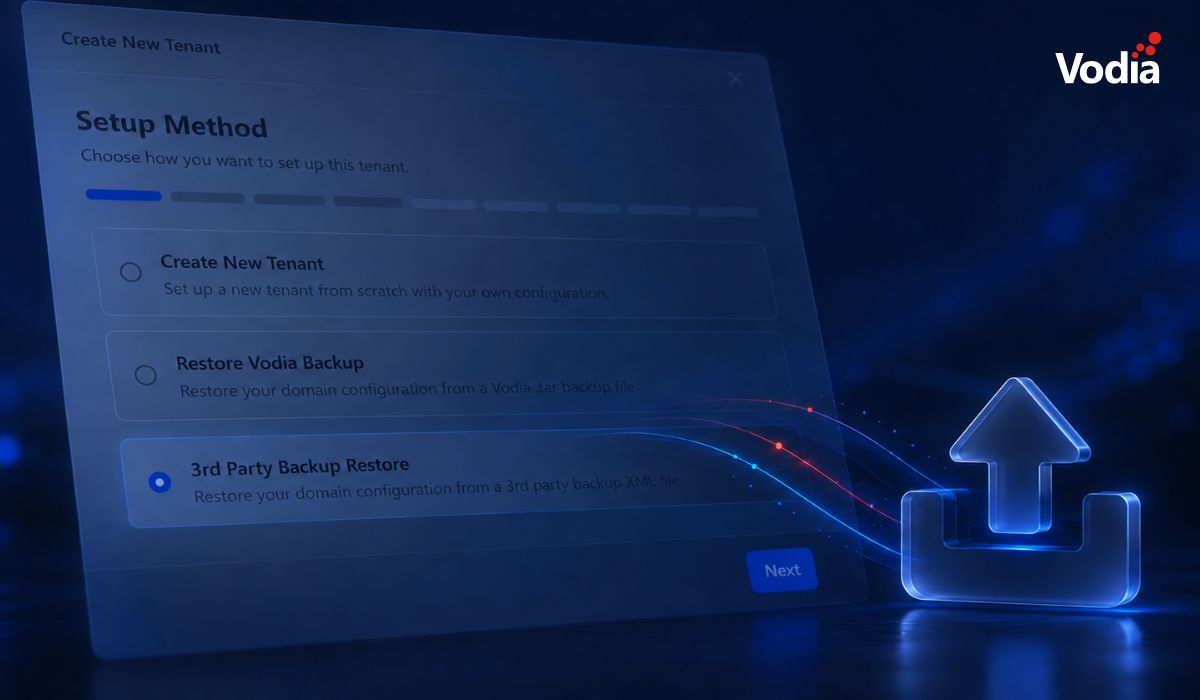
Switching phone systems doesn’t have to mean rebuilding everything from scratch. The Vodia PBX migration tool imports key configuration data from backups, including extensions, ring groups, queues, desk phones, and basic auto-attendant settings. Built into the Vodia Admin Portal, it guides administrators through the import process and reduces repetitive manual work, whether you’re moving 10 extensions or 1,000. Explore what transfers, what needs manual setup, and how the built-in tool reduces repetitive work when moving to Vodia.
.svg)